
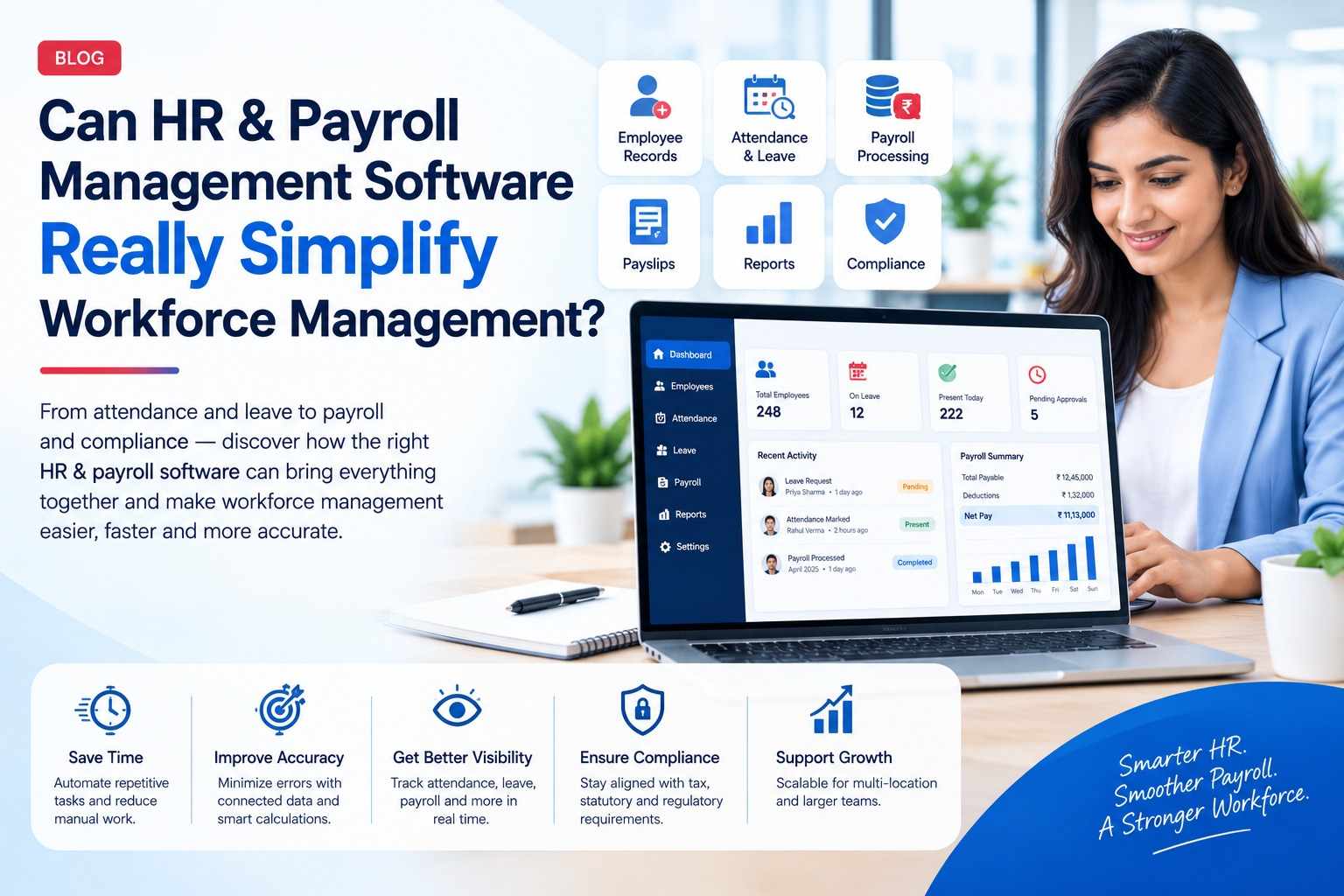
Managing employees involves far more than calculating salaries at the end of each month. HR teams handle attendance, leave requests, employee records, onboarding, payroll, compliance, performance information, and countless routine queries. When these activities are managed through spreadsheets, paper records, and disconnected applications, administrative work can quickly become difficult to control. HR & Payroll management software brings many of these processes into a connected digital workflow, helping organizations manage workforce information more systematically.
The real value of such technology, however, goes beyond salary calculation. It can help HR teams organize employee data, standardize routine processes, reduce repetitive work, and provide management with clearer workforce information.
Quick Answer: What Can HR & Payroll Software Do?
HR and payroll platforms can manage employee records, attendance, leave, payroll processing, payslips, onboarding, reporting, and other workforce activities from a centralized system. By connecting these functions, organizations can reduce duplicate data entry and make routine HR processes easier to track and manage.
Why Is Payroll Only One Part of the Picture?
Payroll is important, but it is just one stage in the employee lifecycle.
Consider a typical employee journey:
Hiring → Onboarding → Attendance → Leave → Payroll → Performance → Exit
Each stage generates information that may be relevant to HR, finance, managers, and employees.
When every activity is handled separately, teams may need to repeatedly update employee information. A connected platform can allow relevant data to flow between appropriate workflows.
For example, approved attendance and leave information may be used as part of payroll preparation, depending on the organization's configuration and policies.
Also read: The Hidden Challenges of OPD Management—and How Software Can Help
How Does HR Software Simplify Employee Management?
A centralized employee record can contain information such as:
Employee contact details
Department and designation
Joining date
Attendance records
Leave history
Compensation information
Documents
Employment status
Relevant HR records
This can make information easier for authorized users to locate and update.
It also creates a clearer reference point when HR teams need to answer routine questions or prepare reports.
Can It Automate Attendance and Leave Management?
Attendance and leave administration can consume considerable HR time, particularly in organizations with many employees or multiple locations.
A suitable platform can support workflows such as:
Employees submitting leave requests.
Managers reviewing requests.
Approved leave being recorded against employee balances.
Attendance information being maintained centrally.
Relevant information being considered during payroll processing.
Organizations can configure these workflows according to their internal policies.
Automation does not remove the need for managerial approval. Instead, it provides a structured way to move requests through the appropriate process.
What Should You Look for in the Best HR & Payroll Management Software?
There is no universal definition of the best HR & Payroll Management Software because requirements vary by organization.
Before choosing a solution, businesses should evaluate:
Employee Management
Can the system maintain accurate employee records and employment information?
Attendance and Leave
Does it support the organization's working schedules, leave policies, approvals, and attendance requirements?
Payroll
Can it handle the organization's salary structures, deductions, allowances, payslips, and applicable payroll requirements?
Reporting
Can HR and management generate useful reports without extensive manual spreadsheet work?
Employee Self-Service
Can employees access appropriate information or submit requests without depending on HR for every routine task?
Security
Does the platform provide suitable access controls, authentication, backups, and audit capabilities?
A feature-rich system is not necessarily the right choice if employees find it difficult to use.
How Can HR & Payroll Software Help Reduce Administrative Work?
The biggest benefit may come from reducing repetitive activities.
For example, HR teams may otherwise spend time:
Updating employee records in multiple files
Calculating leave balances manually
Preparing individual payslips
Consolidating attendance information
Creating recurring reports
Responding to routine employee queries
A centralized workflow can reduce some of this repetitive effort and allow HR professionals to spend more time on activities requiring human judgment, such as employee engagement, workforce planning, and organizational development.
What Should Indian Businesses Consider?
Organizations evaluating HR & Payroll Management Software in India should consider the payroll and employment requirements relevant to their workforce, location, industry, and organizational structure.
Depending on the circumstances, payroll processes may involve areas such as tax deductions, provident fund, employee state insurance, professional tax, leave policies, and applicable labour requirements.
These rules can change and may depend on employee circumstances and jurisdiction. Businesses should therefore validate configuration and compliance requirements with qualified HR, payroll, tax, or legal professionals rather than assuming that software alone guarantees compliance.
What Are the Practical Benefits for HR Teams?
A well-implemented system can provide several operational advantages:
Better visibility into workforce information
More consistent HR processes
Reduced duplicate data entry
Easier access to employee records
Structured approval workflows
Faster preparation of routine reports
Greater transparency for employees
However, implementation quality matters. Poor data migration, unclear responsibilities, inadequate training, or excessive customization can reduce the benefits of a digital system.
Key Takeaways
HR technology is about much more than salary processing.
Employee records, attendance, leave, payroll, and reporting can be connected.
Automation can reduce repetitive administrative activities.
Employee self-service can simplify routine HR requests.
Security and access controls are essential for workforce information.
Indian organizations should validate payroll and compliance requirements carefully.
Software should be selected according to actual business workflows rather than feature count alone.
Conclusion
Modern HR management involves an interconnected employee lifecycle rather than a single monthly payroll task. From employee records and attendance to leave, payroll, reporting, and self-service, a centralized approach can make everyday processes easier to organize and monitor.
Businesses evaluating HR & Payroll management software should focus on workflow compatibility, usability, security, scalability, reporting, and applicable payroll requirements. The right system should support HR professionals rather than replace the human decisions that make effective workforce management possible.
FAQs
What is HR and payroll management software? — It is a digital platform that helps organizations manage employee information, attendance, leave, payroll, and related HR processes.
Can HR software manage attendance and leave? — Yes, many platforms provide attendance tracking and configurable leave management workflows.
Can employees access their payroll information? — Depending on the platform, employees may be able to access payslips and submit or track HR requests through self-service features.
Does HR software guarantee payroll compliance? — No; software can support configured processes, but organizations remain responsible for verifying applicable legal and payroll requirements.
Is HR and payroll software useful for growing companies? — It can be particularly useful when increasing employee numbers make manual workforce administration more difficult.
Write a comment ...